 ISO 9001 / IATF 16949 Certified
Up to 50 MGOe
NdFeB Energy Product
22-32 MGOe
SmCo Energy Product
250-350°C
Max Working Temp (SmCo)
450-550°C
Max Working Temp (Alnico)
0.8-5.3 MGOe
Ferrite Energy Product
Rotor & Stator assemblies available
Custom Assemblies

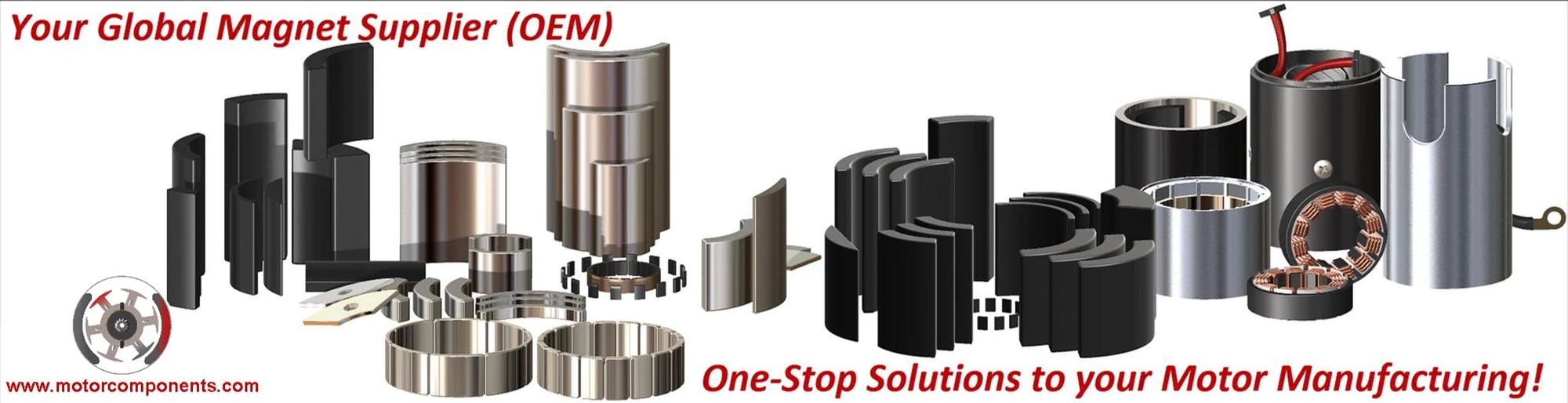
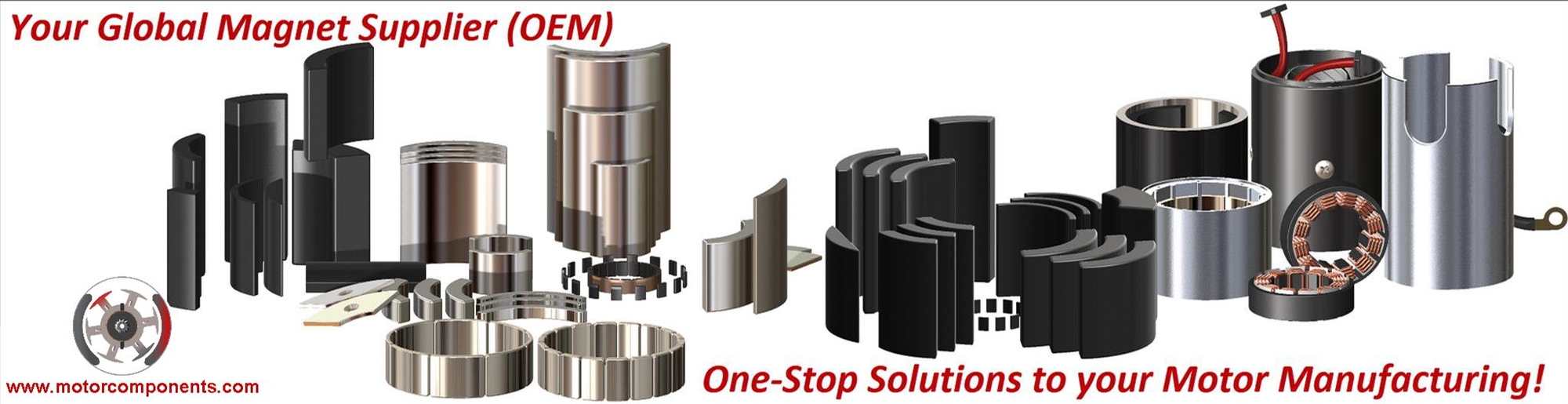
High-quality, low-cost permanent magnets and magnetic components for OEM manufacturing
A permanent magnet is an object made from a material that is magnetized and creates its own persistent magnetic field. We offer comprehensive permanent magnet solutions including various types and grades.
Our range includes Ceramic (Ferrite), Alnico, Samarium Cobalt, Neodymium Iron Boron, Bonded, and Flexible magnets. We also provide magnetic rotor and stator assemblies.
| Material | Specification |
|---|---|
| Ferrite / Ceramic | Isotropic and anisotropic ferrite families, including Ceramic 1, 5 and 8 references in the supplied documentation |
| NdFeB | Sintered and bonded neodymium-iron-boron magnet families |
| SmCo | Samarium-cobalt families including Sm1Co5 and Sm2Co17 |
| Alnico | Cast and sintered Alnico, including common Alnico 5 and 8 references |
| Bonded / Flexible Magnets | Injection-moulded, bonded and flexible magnet formats for suitable geometries and applications |
| FeCrCo | Iron-chromium-cobalt magnet family referenced in the supplied temperature table |
HVAC, wiper, window-lift, sunroof, seat, mirror, EPS, pumps, ABS, parking, starter motors, micromotors and sensors
FHP motors, mixer motors, brushless DC motors, PMDC motors, pump motors and micromotors
DC and PMDC motors, step motors, servo motors, traction motors, generators, tacho generators and actuators
EV, electrical/electronics, aeronautical, marine and medical applications listed in the supplied capability documentation
Sensors, instruments, meters, actuators, electric motors, loudspeakers and lock mechanisms where Alnico characteristics suit the duty
Technical material reference
The permanent-magnet documents cover ferrite, Alnico, samarium cobalt, neodymium iron boron, bonded / injection-moulded and flexible magnets. Selection is driven by magnetic performance, temperature, corrosion environment, mechanical strength, geometry and cost.
| Magnet family | Key characteristics from the supplied documents |
|---|---|
| Ferrite / ceramic | Low cost, high coercive force and good corrosion resistance; mechanically brittle with lower energy product. |
| Alnico | Excellent temperature stability, strong corrosion resistance and good mechanical strength, but relatively low coercivity. |
| Samarium cobalt (SmCo) | High energy product, high coercivity, good corrosion resistance and strong high-temperature capability; brittle and comparatively costly. |
| Neodymium iron boron (NdFeB) | Very high energy product and coercivity; requires attention to corrosion protection and application temperature. |
| Bonded / injection-moulded | Resin-plus-magnetic-powder construction supports complex shapes, with magnetic performance dependent on powder loading. |
| Flexible magnets | Produced as flexible strips or sheets, typically with lower magnetic strength but good design flexibility. |
| Type | Documented maximum working temperature |
|---|---|
| Cast Alnico | 450–550°C |
| Sintered Alnico | 450°C |
| Sintered SmCo | 250–350°C depending on grade |
| Sintered NdFeB | 80–250°C depending on grade |
| Bonded NdFeB | 120–180°C |
| Ferrite | Up to about 250°C for sintered grades in the supplied table |
| Flexible ferrite | Approximately -40 to 100°C in the supplied table |
The dedicated Alnico document describes cast and sintered Alnico as hard, brittle materials that are normally finished by abrasive grinding rather than conventional machining. Simple sections are preferred, slots are generally preferable to drilled holes, and close-tolerance surfaces are normally ground. Cast Alnico supports complex forms; sintered Alnico generally offers tighter tolerances and stronger mechanical consistency.
Technical information is presented from Motor Components Ltd capability documentation and should be matched to the drawing, material, duty and production requirement for each enquiry.
Detailed technical information
Technical wording, tables and graphics below are reproduced from the supplied Motor Components capability material and are displayed directly on this product page.
Your source for high-quality, low-cost permanent magnets and magnetic components and assemblies for your OEM electric motor manufacturing.
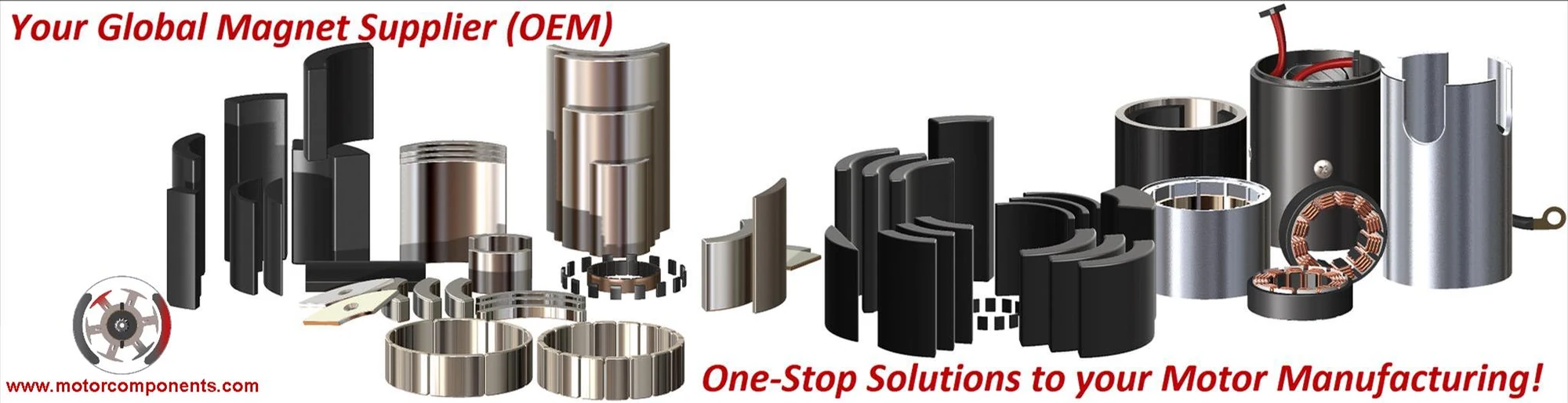
A permanent magnet is an object made from a material that is magnetized and creates its own persistent magnetic field. Materials that can be magnetized, which are also the ones that are strongly attracted to a magnet, are called ferromagnetic (or ferrimagnetic). These include the elements iron, nickel and cobalt and their alloys, some alloys of rare-earth metals, and some naturally occurring minerals such as lodestone. Although ferromagnetic (and ferrimagnetic) materials are the only ones attracted to a magnet strongly enough to be commonly considered magnetic, all other substances respond weakly to a magnetic field, by one of several other types of magnetism.
But in certain materials, called ferromagnets, all the spins and the orbits of the electrons will line up, causing the materials to become magnetic. This would be your normal iron, cobalt, nickel. Permanent magnets are limited by the structure of the material. And the strongest magnetic field of a permanent magnet is about 8,000 gausses.
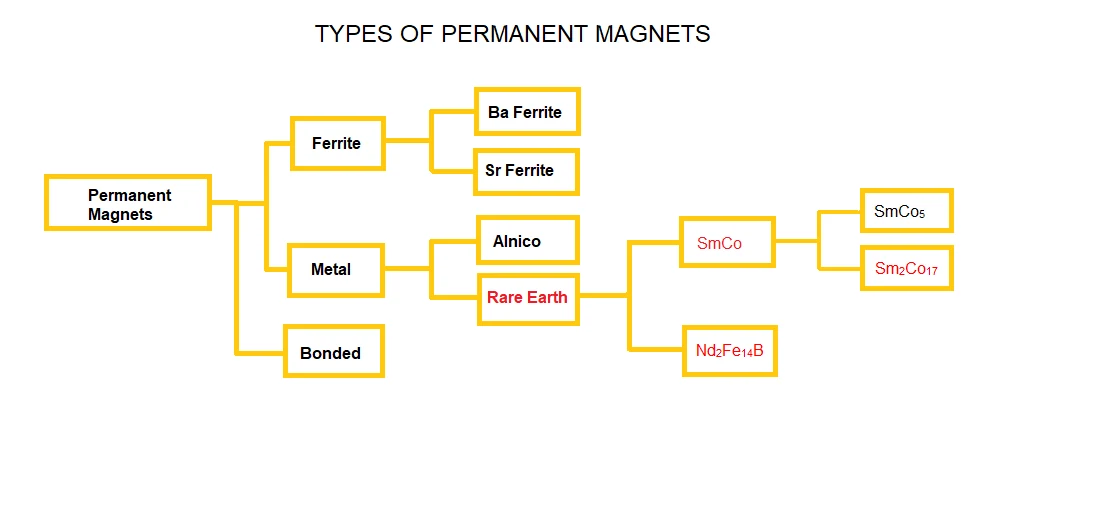
Ceramic, also known as Ferrite, magnets are made of a composite of iron oxide and barium or strontium carbonate. These materials are readily available and at a lower cost than other types of materials used in permanent magnets making it desirable due to the lower cost. Ceramic magnets are made using pressing and sintering. These magnets are brittle and require diamond wheels if grinding is necessary. These magnets are also made in different grades. Ceramic-1 is an isotropic grade with equal magnetic properties in all directions. Ceramic grades 5 and 8 are anisotropic grades. Anisotropic magnets are magnetized in the direction of pressing. The anisotropic method delivers the highest energy product among ceramic magnets at values up to 3.5 MGOe (Mega Gauss Oersted). Ceramic magnets have a good balance of magnetic strength, resistance to demagnetizing and economy. They are the most widely used magnets today.
| Positive | Negative |
| Low Cost | Low Energy Product |
| High Coercive Force | Low Mechanical Strength - Brittle |
| High Resistance to Corrosion |
Alnico magnets are made up of a composite of aluminium, nickel and cobalt with small amounts of other elements added to enhance the properties of the magnet. Alnico magnets have good temperature stability, good resistance to demagnetization due to shock but they are easily demagnetized. Alnico magnets are produced by two typical methods, casting or sintering. Sintering offers superior mechanical characteristics, whereas casting delivers higher energy products (up to 5.5 MGOe) and allows for the design of intricate shapes. Two quite common grades of Alnico magnets are 5 and 8. These are anisotropic grades and provide for a preferred direction of magnetic orientation. Alnico magnets have been replaced in many applications by ceramic and rare earth magnets.
| Positive | Negative |
| High Corrosion Resistance | High Cost |
| High Mechanical Strength | Low Coercive Force |
| High Temperature Stability | Low Energy Product |
Samarium cobalt is a type of rare earth magnet material that is highly resistant to oxidation, has a higher magnetic strength and temperature resistance than Alnico or Ceramic material. Introduced to the market in the 1970's, samarium cobalt magnets continue to be used today. Samarium cobalt magnets are divided into two main groups: Sm1Co5 and Sm2Co17 (commonly referred to as 1-5 and 2-17). The energy product range for the 1-5 series is 15 to 22 MGOe, with the 2-17 series falling between 22 and 32 MGOe. These magnets offer the best temperature characteristics of all rare earth magnets and can withstand temperatures up to 300° C. Sintered samarium cobalt magnets are brittle and prone to chipping and cracking and may fracture when exposed to thermal shock. Due to the high cost of the material samarium, samarium cobalt magnets are used for applications where high temperature and corrosion resistance is critical.
| Positive | Negative |
| High Corrosion Resistance | High Cost |
| High Energy Product | Low Mechanical Strength - Brittle |
| High Temperature Stability | |
| High Coercive Force |
Neodymium Iron Boron (NdFeB) is another type of rare earth magnetic material. This material has similar properties as the Samarium Cobalt except that it is more easily oxidized and generally does not have the same temperature resistance. NdFeB magnets also have the highest energy products approaching 50MGOe. These materials are costly and are generally used in very selective applications due to the cost. Cost is also driven by existing intellectual property rights of the developers of this type of magnet. Their high energy products lend themselves to compact designs that result in innovative applications and lower manufacturing costs. NdFeB magnets are highly corrosive. Surface treatments have been developed that allow them to be used in most applications. These treatments include gold, nickel, zinc and tin plating and epoxy resin coating.
| Positive | Negative |
| Very High Energy Product | Higher Cost (Except from us!) |
| High Coercive Force | Low Mechanical Strength - Brittle |
| Moderate Temperature Stability | |
| Low Corrosion Resistance (uncoated) |
Injection mouldable magnets are a composite of resin and magnetic powders of different materials allowing parts to be made in an injection molding process. Energy products are dependent upon the magnetic powders used in fabrication. The molding process allows for the manufacture of more complex shapes. These magnets are usually lower in magnetic strength as there are limitations to the degree of loading.
| Positive | Negative |
| Moderate Energy Product | High Cost |
| Moderate Coercive Force | Low Temperature Stability |
| High Corrosion Resistance | |
| Highly Shapeable |
Flexible magnets are very similar to the injection molded magnets but are produced in flat strips and sheets. These magnets are lower in magnetic strength and very flexible depending on the materials that was used in the compound with the magnetic powders. Vinyl is often used in this type of magnet as the binder.
| Positive | Negative |
| Low Cost | Low Energy Product |
| High Corrosion Resistance | Low to Medium Temperature Stability |
| Moderate Coercive Force |
| Material | Grade | Br | Hc | Hci | BHmax | Tmax (°C) * |
| NdFeB | 39H | 12,800 | 12,300 | 21,000 | 40 | 150 |
| SmCo | 26 | 10,500 | 9,200 | 10,000 | 26 | 300 |
| NdFeB | B10N | 6,800 | 5,780 | 10,300 | 10 | 150 |
| Alnico | 5 | 12,500 | 640 | 640 | 5.5 | 540 |
| Ferrite | 8 | 3,900 | 3,200 | 3,250 | 3.5 | 300 |
| Flexible | 1 | 1,600 | 1,370 | 1,380 | 0.6 | 100 |
| Magnet Types | Maximum Working Temperature | Curie Temperature |
| °C | °C | |
| NdFeB | ||
| N | 80 | 310 |
| M | 100 | 340 |
| H | 120 | 340 |
| SH | 150 | 340 |
| UH | 180 | 350 |
| EH | 200 | 350 |
| AH | 230 | 350 |
| Sintered-NdFeB | 80-250 | 350 |
| Bonded-NdFeB | 120-180 | - |
| SmCo | ||
| Sintered-SmCo5 | 250 | 750 |
| Sintered-Sm2Co17 | 250-350 | 800 |
| Bonded-SmCo | 120 | - |
| Alnico | ||
| Sintered | 450 | 760-890 |
| Cast | 450-550 | 810-890 |
| FeCrCo | 400 | 680 |
| Ferrite | 250 | 450 |
| Sintered-Ferrite | -40 - 250 | 450 |
| Bonded-Ferrite | 120 | - |
| Flexible | -40-100 | - |
| Magnet Types | Maximum Working Temperature | Curie Temperature |
| °C | °C | |
| NdFeB | ||
| N | 80 | 310 |
| M | 100 | 340 |
| H | 120 | 340 |
| SH | 150 | 340 |
| UH | 180 | 350 |
| EH | 200 | 350 |
| AH | 230 | 350 |
| Sintered-NdFeB | 80-250 | 350 |
| Bonded-NdFeB | 120-180 | - |
| SmCo | ||
| Sintered-SmCo5 | 250 | 750 |
| Sintered-Sm2Co17 | 250-350 | 800 |
| Bonded-SmCo | 120 | - |
| Alnico | ||
| Sintered | 450 | 760-890 |
| Cast | 450-550 | 810-890 |
| FeCrCo | 400 | 680 |
| Ferrite | 250 | 450 |
| Sintered-Ferrite | -40 - 250 | 450 |
| Bonded-Ferrite | 120 | - |
| Flexible | -40-100 | - |
| Magnet type | (BH) Max (MGOe) | Max. working Temperature(°C) | Curie Temperature (°C) | Anti-corrosion | Machinability |
| Ferrite Magnets | 0.8-5.3 | 450 | 250 | Good | Normal |
| Sintered NdFeB Magnets | 27~52 | 310 ~370 | 80~230 | Bad | Normal |
| Bonded NdFeB magnets | 3~12 | 350 | 160 | Good | Good |
| SmCo5 Magnets | 14~25 | 750 | 250 | Good | Normal |
| Sm2Co17 Magnets | 22~32 | 800~840 | 350 | Good | Normal |
| Bonded SmCo | 4.0~15 | 120 | 720 | Good | - |
| Alnico Magnets | 11.5 | 890 | 500 | Good | Fair |
| Bonded Magnets | 3-12 | 350 | 160 | Good | Good |
AUTOMOTIVE 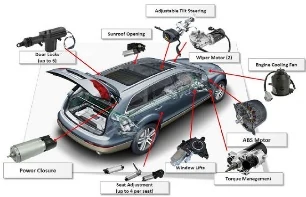 | HVAC motors Window wiper motors Window lift motors Sunroof motors Seat adjuster motors Mirror adjuster motors EPS- Electric Power steering motors Washer pump motors Fuel pump motors ABS motors APS/parking Motors Power antenna motors Starter motors Micromotors Sensors | 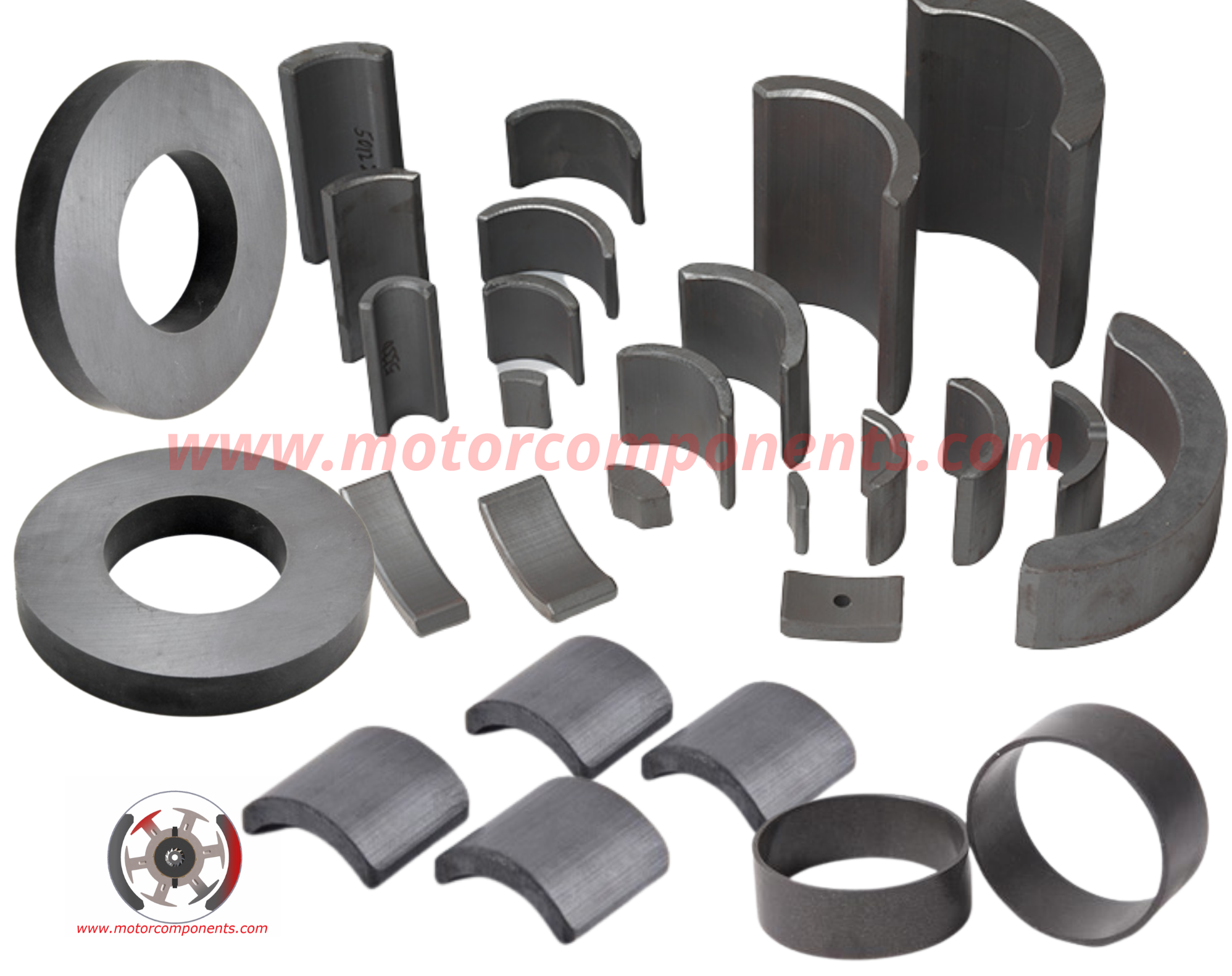 |
HOME APPLIANCES  | FHP motors Mixer motors Brushless DC Motors PMDC Motors Pump Motors Micromotors / DC Motors | 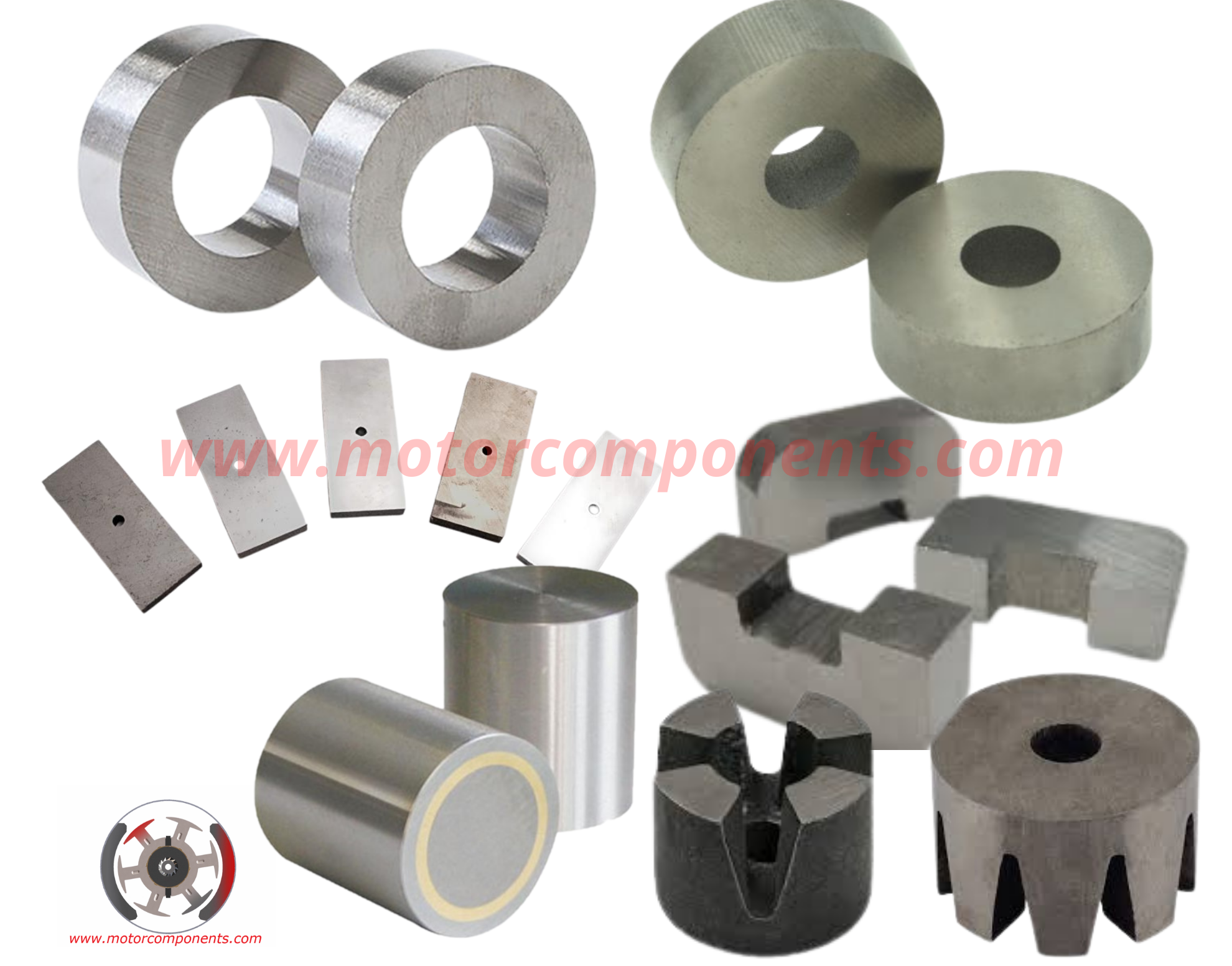 |
INDUSTRIAL MOTORS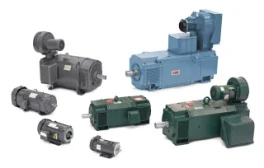 | DC Motors PMDC motors Step motors Servo motors Traction motors DC generators Ex-proof motors Tacho generators / Actuators | 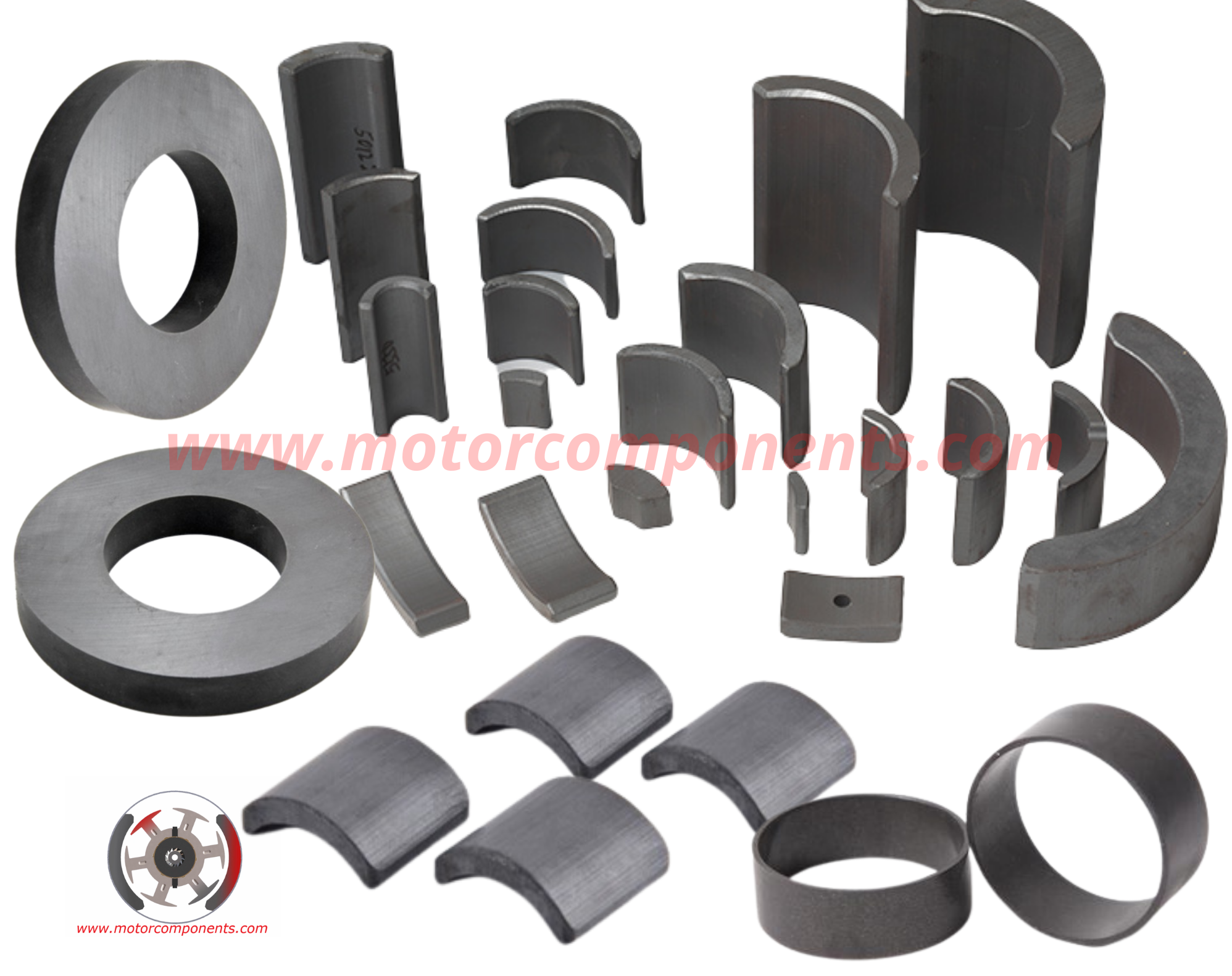 |
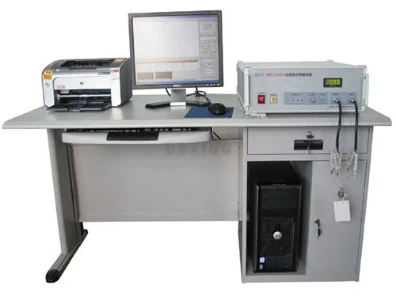
Our stringent quality management ensures product consistency covering all processes from raw material procurement to finished goods production. The products and processes pass through stringent quality tests benchmarked with global standards.
Our manufacturing facilities are ISO 9001:2015 or IATF/TS16949 certified. Our greatest asset is delivering outstanding product quality and first-class service to our customers globally.
Our components are efficiently manufactured to give our customers very competitive pricing without compromising product quality.
We offer warehousing locations across the UK and Europe that are set up for stocking programs and deliveries to match customer specific manufacturing and inventory requirements.
If you would like to know more about our extensive range of permanent magnet products please contact us.
Detailed technical information
Technical wording, tables and graphics below are reproduced from the supplied Motor Components capability material and are displayed directly on this product page.
| "Specialist suppliers of OEM motor components,  OEM electric motors" | 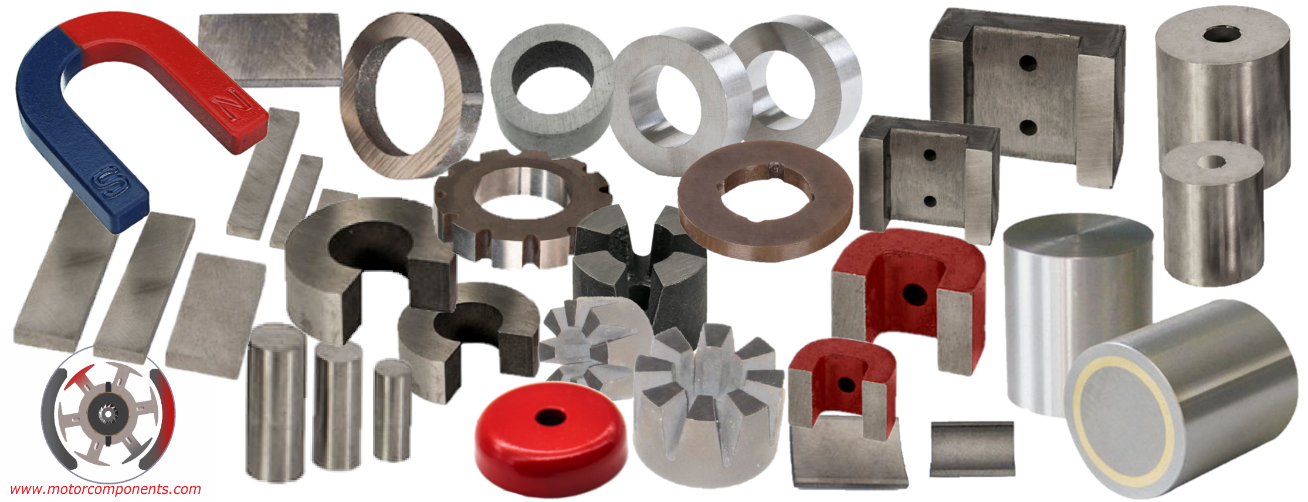 | MOTOR VIDEO HERE We/You can use one of the following videos. We will also use other videos according to products! Motor-Video-1 Motor-Video-2  |
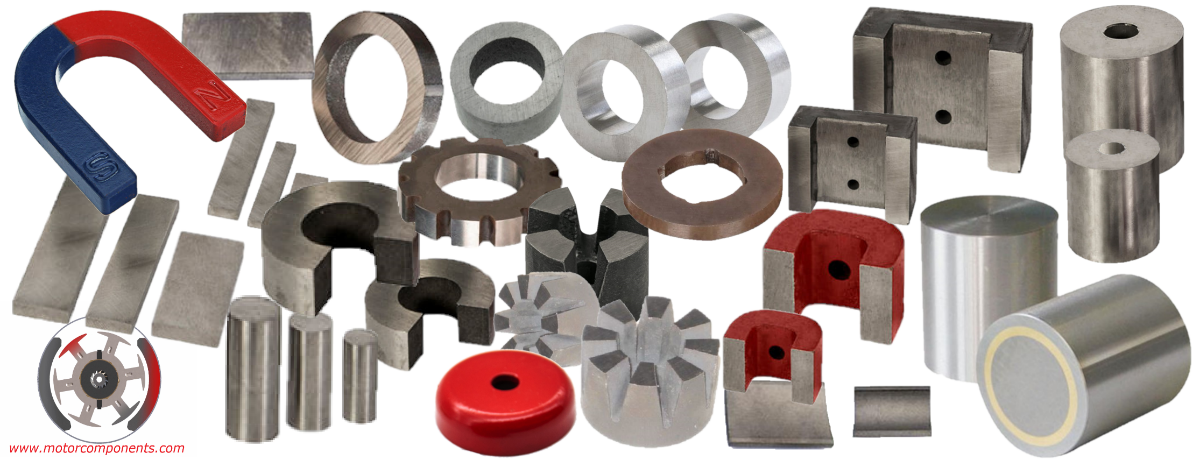
Alnico was the strongest permanent magnet available until rare earth magnets were developed.
Alnico magnets, composed of primarily Aluminium (Al), Nickel (Ni), Cobalt (Co), and also sometimes copper, titanium and iron, were developed in the 1940s. This class of magnet remains a preferred material because of its excellent temperature stability, high magnetic flux density, and corrosion resistance. There are plenty of trade names are used for different grades such as Columax, Alcomax 3SC, Alni etc.
The most commonly used grade names are; Alnico 5, Alnico 8, Alnico 9, Alnico 5DG, Alnico5-7, Alnico8HC, Alnico 6, Alnico 2, Alnico3, Alnico 500, Alnico 400, Alnico 600 and Alnico 700, etc.
Alnico magnets are widely used today in applications where strong permanent magnets are needed and/or high temperatures are present, in applications requiring low coercivities (the ability to demagnetize and re-magnetize easily). Also has good resistance to demagnetization from vibration and shock.
The advantages of alnico magnets are high magnetic flux density, low-temperature coefficient of magnetic properties, high mechanical strength, and very stable magnets. Alnico magnets are generally (approx. four times) stronger than regular ferrite (ceramic) magnets, but not as strong as rare-earth magnets, they are also electrically conductive, unlike ceramic/ferrite magnets. Alnico magnets are available in either isotropic or anisotropic versions.
On a cost per pound basis, this material is comparable to the cost of neodymium magnets. However, in most applications, alnico is much less powerful than Neodymium magnets.
However, the coercive force and maximum energy product are not high. They limit their applications in many cases.
There are two production processes used to manufacture Alnico Magnets: casting and sintering, magnetization is possible only in axial direction.
AlNiCo magnets have high remanence, but low coercivity - this fact determines the magnetization direction. Optimal ratio of diameter and length of the magnet is 1:4. Magnetic field of AlNiCo magnets can be weakened by demagnetizing. AlNiCo is a hard material, machining is possible by grinding. Working temparature is between -270°C and +500°C. AlNiCo magnets are resistant against acids and solvents.
The casting process allows the magnet to be manufactured into complex shapes. Sintered Alnico is made from a powdered mixture of ingredients that are pressed into a die under tons of pressure. The Sintering process allows for the magnets to be manufactured to tighter tolerances and higher mechanical strength.
Alnico magnets have high magnetic flux density, high resistance to corrosion and excellent temperature stability. Though the corrosion resistance of alnico is excellent and, in most cases, no surface treatments are required, alnico magnets can be plated for aesthetic applications.
Alnico magnets are widely used in industrial and consumer applications where strong permanent magnets are needed and/or high temperatures are present.
What makes Alnico a preferred magnet material for many manufacturers is its high induction levels with good resistance to demagnetization and stability. This occurs because industrial sintered alnico magnets have a low-temperature coefficient and are produced at an affordable cost.
Caution!
Special care should be taken to ensure that these magnets are not subject to adverse repelling fields since these could partially de-magnetize the magnets. If alnicos are partially de-magnetized however, they can be easily re-magnetized.
The lower coercive force of Alnico makes magnetizing a simple matter in most cases. To optimize the performance of Alnico magnets, it is advisable to magnetize the magnet after assembly with other circuit components.
| MANUFACTURING | STANDARDS SPECIFICATIONS | BH CURVES | SURFACE TREATMENTS | DESIGN CONSIDERATION | APPLICATIONS | GALLERY |
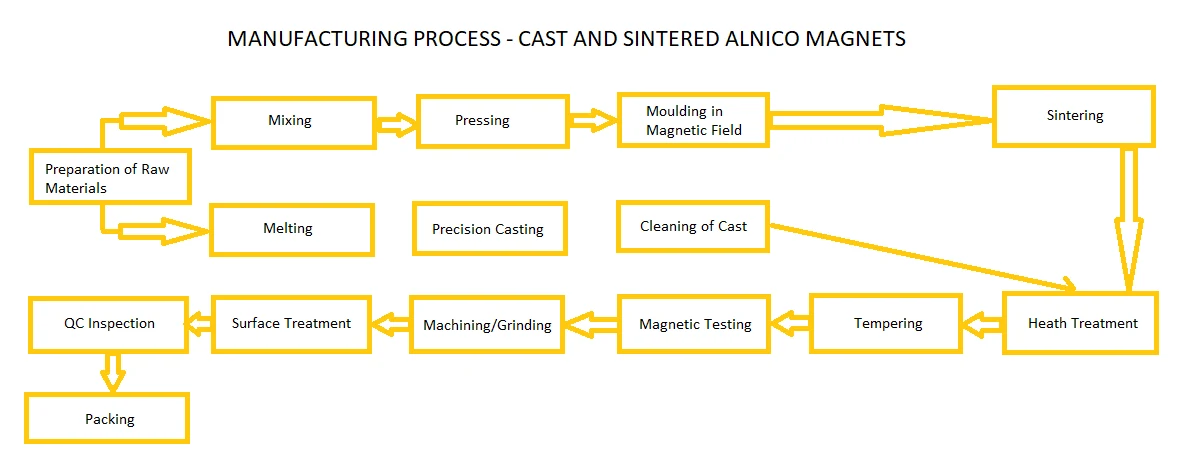
Most alnico produced is anisotropic, meaning that the magnetic direction of the grains is oriented in one direction. This orientation is achieved via heat treatment after casting or sintering. The process involves heating the cast or sintered part above its Curie temperature and then cooling it at a controlled rate in the presence of a strong directional magnetic field. Final shaping of the alnico materials is achieved by abrasive grinding and cutting where close tolerances are required.
| MANUFACTURING | STANDARDS SPECIFICATIONS | BH CURVES | SURFACE TREATMENTS | DESIGN CONSIDERATION | APPLICATIONS | GALLERY |
↓
Cast alnico, magnets are produced by conventional foundry methods using resin bonded sand moulds.
| Magnetic and Physical Properties of Cast Alnico Magnet | |||||||||||||
| Grades | Equivalent MMPA Class | Remanence | Coercive Force | Maximum Energy Product | Density | Reversible Temp. Coefficient | Reversible Temp. Coefficient | Curie Temp | Temp. Coefficient | Remark | |||
| Br | Hcb | (BH)max | g/cm³ | α(Br) | α(Hcj) | TC | TW | ||||||
| mT | Gs | KA/m | Oe | KJ/m3 | MGOe | %/℃ | %/℃ | ℃ | ℃ | ||||
| LN10 | ALNICO 3 | 600 | 6000 | 40 | 500 | 10 | 1.2 | 6.9 | -0.03 | -0.02 | 810 | 450 | Isotropy |
| LNG13 | ALNICO 2 | 700 | 7000 | 48 | 600 | 12.8 | 1.6 | 7.2 | -0.03 | +0.02 | 810 | 450 | |
| LNGT18 | ALNICO 8 | 580 | 5800 | 100 | 1250 | 18 | 2.2 | 7.3 | -0.025 | +0.02 | 860 | 550 | |
| LNG37 | ALNICO 5 | 1200 | 12000 | 48 | 600 | 37 | 4.65 | 7.3 | -0.02 | +0.02 | 850 | 525 | Anisotropy |
| LNG40 | 1250 | 12500 | 48 | 600 | 40 | 5 | 7.3 | ||||||
| LNG44 | 1250 | 12500 | 52 | 650 | 44 | 5.5 | 7.3 | ||||||
| LNG52 | ALNICO 5DG | 1300 | 13000 | 56 | 700 | 52 | 6.5 | 7.3 | |||||
| LNG60 | ALNICO5-7 | 1350 | 13500 | 59 | 740 | 60 | 7.5 | 7.3 | |||||
| LNGT28 | ALNICO 6 | 1000 | 10000 | 57.6 | 720 | 28 | 3.5 | 7.3 | -0.02 | +0.03 | 850 | 525 | |
| LNGT36J | ALNICO 8HC | 700 | 7000 | 140 | 1750 | 36 | 4.5 | 7.3 | -0.025 | +0.02 | 860 | 550 | |
| LNGT38 | ALNICO 8 | 800 | 8000 | 110 | 1380 | 38 | 4.75 | 7.3 | -0.025 | +0.02 | 860 | 550 | |
| LNGT40 | 820 | 8200 | 110 | 1380 | 40 | 5 | 7.3 | -0.025 | 860 | 550 | |||
| LNGT60 | ALNICO 9 | 900 | 9000 | 110 | 1380 | 60 | 7.5 | 7.3 | -0.025 | +0.02 | 860 | 550 | |
| LNGT72 | 1050 | 10500 | 112 | 1400 | 72 | 9 | 7.3 | -0.025 | 860 | 550 |
| Sintered AlNiCo Typical Magnetic Properties | |||||||||||
| Grade | Remanence | Coercivity | Intrinsic Coercivity | Max. Energy Product | Density | Working | Remark | ||||
| Temp | |||||||||||
| Br | Hcb | Hcj | (BH)max | Tc | |||||||
| KGs | T | KOe | Ka/m | KOe | Ka/m | MGOe | Kj/m3 | g/cm3 | ℃ | ||
| FLN8 | 5.2 | 0.52 | 0.5 | 40 | 0.54 | 43 | 1.0-1.25 | 8-10 | 6.8 | 760 | Isotropic |
| FLNG12 | 7 | 0.7 | 0.5 | 40 | 0.54 | 43 | 1.5-1.75 | 12-14 | 7 | 810 | |
| FLNGT14 | 5.7 | 0.57 | 0.95 | 76 | 0.98 | 78 | 1.75-2.0 | 14-16 | 7.1 | 850 | |
| FLNGT18 | 5.6 | 0.56 | 1.1 | 88 | 1.13 | 90 | 2.25-2.75 | 18-22 | 7.2 | 850 | |
| FLNG28 | 10.5 | 1.05 | 0.58 | 46 | 0.59 | 47 | 3.5-4.15 | 28-33 | 7.2 | 850 | Anisotropic |
| FLNG34 | 11 | 1.1 | 0.63 | 50 | 0.64 | 51 | 4.3-4.8 | 34-38 | 7.2 | 890 | |
| FLNGT28 | 10 | 1 | 0.7 | 56 | 0.71 | 57 | 3.5-3.8 | 28-30 | 7.2 | 850 | |
| FKNGT31 | 7.8 | 0.78 | 1.3 | 104 | 1.13 | 90 | 3.9-4.5 | 31-36 | 7.2 | 890 | |
| FLNG33J | 6.5 | 0.65 | 1.7 | 135 | 1.88 | 150 | 4.15-4.5 | 33-36 | 7.2 | 850 | |
| FLNGT38 | 8 | 0.8 | 1.55 | 123 | 1.58 | 126 | 4.75-5.3 | 38-42 | 7.2 | 850 | |
| FLNGT42 | 8.8 | 0.88 | 1.5 | 120 | 1.53 | 122 | 5.3-6.0 | 42-48 | 7.25 | 850 |
Max Working Temperature of AlNiCo ranges from 450°C to 550°C. There are two kinds of AlNiCo, Sintered AlNiCo and Cast AlNiCo. Cast magnets may be manufactured in complex shapes and the mould charge (sand mould) is cheap. But due to the sand mould edges, cast alnico has darkened edges with a slightly rough texture. To get a smooth surface, grounding is needed. Sintered AlNiCo offer slightly lower magnetic properties but better mechanical characteristics.
Most AlNiCo magnet grades are anisotropic (they can only be magnetized in a single axis /direction – they are the more powerful magnet grades of AlNiCo.
The others are isotropic (Lower grade, they can be magnetized in any direction or directions) – but for these types of alnico magnets, magnetic strength is very low but offer more design and performance flexibility.
Available Shapes: blocks, bars, discs, rings, horseshoes, etc.
Sintered Alnico magnets are formed using powdered metal manufacturing methods. Sintering alnico is suitable for complex geometries
Most Alnico magnet grades are anisotropic (they can only be magnetised in a single axis/direction – they are the more powerful magnet grades of Alnico. The others are isotropic (they can be magnetised in any direction or directions) – they are weaker but offer more design and performance flexibility.
There are 29 grades of Alnico (17 cast grades, 10 sintered grades, 2 bonded grades).
| Main Elements within Alnico | Percentage by weight |
| Aluminium(Al) | 6% – 13% |
| Nickel (Ni) | 13% – 26% |
| Cobalt (Co) | 0% – 42% |
| Copper (Cu) | 2% – 6% |
| Titanium (Ti) | 0% -9% |
| Niobium (Nb) | 0% -3% |
| Iron (Fe) | Balance ( 30% -40%) |
| MANUFACTURING | STANDARDS SPECIFICATIONS | BH CURVES | SURFACE TREATMENTS | DESIGN CONSIDERATION | APPLICATIONS | GALLERY |
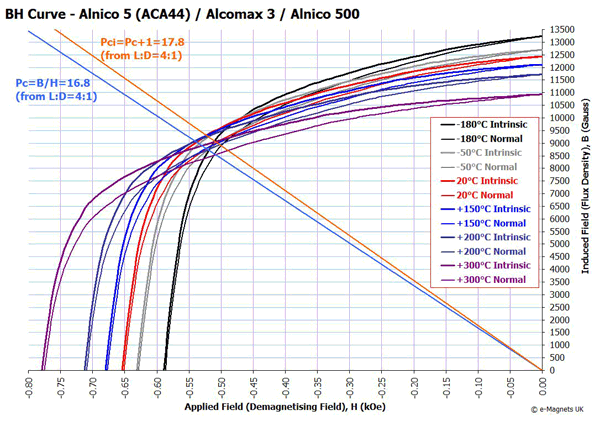
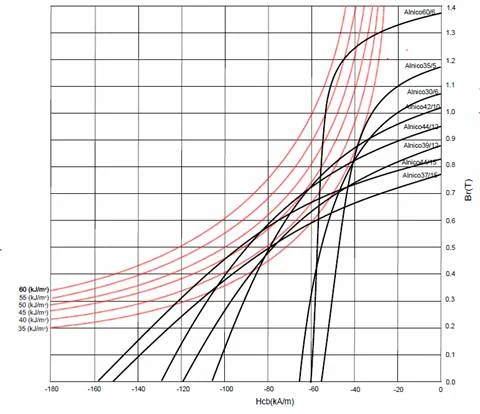
Anisotropic Alnico Magnets:
Isotropic Alnico Magnets:
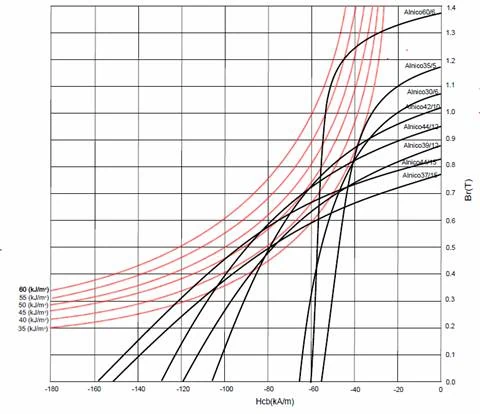
↓
| MANUFACTURING | STANDARDS SPECIFICATIONS | BH CURVES | SURFACE TREATMENTS | DESIGN CONSIDERATION | APPLICATIONS | GALLERY |
↓
Alnico magnets do not usually require a surface finish to prevent corrosion. However, this does depend on the grade of Alnico and the chemicals in the environment. Some grades of Alnico contain iron, so may corrode if it is exposed to water or acids.
They can, however, be easily plated using a variety of metals, such as nickel, zinc, chrome or paint
Cast Alnico materials commonly contain casting voids and hairline cracks within the material. Finish machining can expose these voids and hairline cracks.
| MANUFACTURING | STANDARDS SPECIFICATIONS | BH CURVES | SURFACE TREATMENTS | DESIGN CONSIDERATION | APPLICATIONS | GALLERY |
↓
Alnico Magnets can be made by both cast and sintered processes. Alnico Magnets have distinct advantages over other varieties of permanent magnets in terms of moderate prices & widest temperature stability. Alnico magnets are coarse-grained and very hard and brittle, therefore they cannot be drilled or machined with conventional methods. Holes are usually cored in at the foundry. Magnets are cast or sintered as closely as possible to required size so that abrasive grinding to finish dimensions and tolerances are minimized.
Alnico parts are not normally used as structural parts. Where a choice exists, select simple shapes. Slots are preferred over holes. Cross-sections of less than 0.125" (3.18 mm) should be avoided. Finished surfaces, when required, may be produced by grinding; however, for many applications, the "as cast" or "as sintered" surface yields a satisfactory result at a significantly lower cost. To facilitate mounting and give adequate protection to the magnet, special assemblies such as rotors and magnetron magnets may be supplied with an aluminium jacket. Additionally, low carbon steel pole pieces may be attached to magnet pole faces by adhesive bonding or with studs or bolts. Plastisol or paint can be applied for an improved appearance.
Available Shapes: blocks, bars, discs, rings, horseshoes, etc.
| Magnet Types | Maximum Working Temperature | Curie Temperature |
| °C | °C | |
| NdFeB | ||
| N | 80 | 310 |
| M | 100 | 340 |
| H | 120 | 340 |
| SH | 150 | 340 |
| UH | 180 | 350 |
| EH | 200 | 350 |
| AH | 230 | 350 |
| Sintered-NdFeB | 80-250 | 350 |
| Bonded-NdFeB | 120-180 | - |
| SmCo | ||
| Sintered-SmCo5 | 250 | 750 |
| Sintered-Sm2Co17 | 250-350 | 800 |
| Bonded-SmCo | 120 | - |
| Alnico | ||
| Sintered | 450 | 760-890 |
| Cast | 450-550 | 810-890 |
| FeCrCo | 400 | 680 |
| Ferrite | 250 | 450 |
| Sintered-Ferrite | -40 - 250 | 450 |
| Bonded-Ferrite | 120 | - |
| Flexible | -40-100 | - |
| MANUFACTURING | STANDARDS SPECIFICATIONS | BH CURVES | SURFACE TREATMENTS | DESIGN CONSIDERATION | APPLICATIONS | GALLERY |
↓
Alnico magnets are widely used in industrial and consumer applications where strong permanent magnets are needed and/or high temperatures are present.
We are equipped to manufacture these materials as per customers specifications.
If you would like to know more about our extensive range of magnets products please contact us.
OEM sourcing guidance
Permanent magnets for motor applications are selected around magnetic performance, temperature, corrosion resistance, geometry, magnetisation direction and assembly method. Common material families include NdFeB, SmCo, ferrite and Alnico.
Use these services when the requirement needs development, validation or a new sourcing route.
Buyer questions
The current product range includes NdFeB, SmCo, ferrite, Alnico and other magnet formats listed on the product page.
Dimensions, tolerances, material/grade, magnetisation direction, coating and any assembly or operating-temperature requirements should be included where known.
Yes. Magnet enquiries can be combined with laminations, shafts, housings and other related motor components.
Our stringent quality management ensures product consistency covering all processes from raw material procurement to finished goods production. The products and processes pass through stringent quality tests benchmarked with global standards.
Send us your technical drawings, specifications, or samples for an obligation-free quotation. Our team responds within 24 hours.